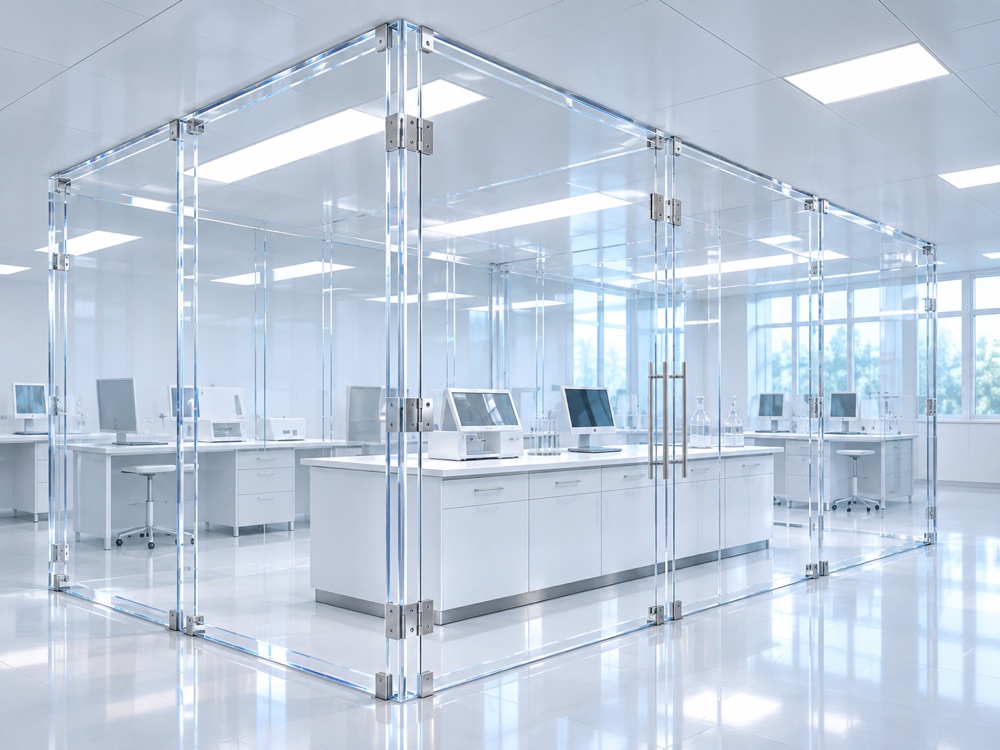
Acrylic can be considered for many transparent fixtures in research and healthcare environments, but the name of the setting is not a specification. An equipment viewing cover, an organiser and a laboratory enclosure have different functions and risks. Start by defining exactly what the assembly will do and which specialist must approve its use. This article concerns project briefing and non-clinical fixture design, not the design or certification of medical devices, biological safety cabinets or containment systems.
Describe the task and its boundaries
State whether the proposed assembly is a passive cover, an access-controlled display, a removable guard or a fixture around an existing instrument. Identify the equipment owner and intended users. Explain what must remain visible and accessible. If the enclosure might affect an instrument's ventilation, operation or maintenance, ask its manufacturer to review the interfaces before a fabrication order is placed.
Do not assume a transparent box provides protection against aerosols, pressure, radiation, fire or impact. If any such protection is required, stop treating the item as an ordinary furniture or enclosure project and obtain the appropriate specialist design and validation. A photograph of similar-looking equipment cannot demonstrate equivalent protection.
Build an interface schedule
Record external dimensions, opening positions, cable and service routes, door travel and removable panels. Show the clearances needed for instrument servicing and routine access. Mark interfaces controlled by another supplier so changes are coordinated rather than improvised in the workshop. Identify whether facilities staff need to remove the entire assembly or only a local cover.
Review a representative access sequence with the users: opening, reaching, inspection and closing. For equipment interfaces, obtain the responsible manufacturer's approval. A concept model may help reveal awkward access, but it does not establish a safety rating or authorise modifications to regulated equipment.
Define cleaning requirements before selecting the material
Obtain the actual maintenance procedure from the facility, including the named products, concentrations, contact conditions and cleaning frequency. Give this information to the material supplier and fabricator for a documented compatibility assessment of the complete assembly. Include adhesives, seals, coatings, hinges and labels, not just the transparent sheet.
Manufacturer care guidance is product-specific. PLEXIGLAS publishes cleaning and maintenance information for its products; it should not be interpreted as permission to apply every hospital disinfectant to every acrylic grade. If infection-control requirements apply, the facility's responsible team must approve the proposed procedure. This guide does not recommend a disinfection recipe or claim a sterile result.
Choose evidence that matches the intended use
Ask for the proposed manufacturer and grade, available technical documentation and the scope of any supporting test. Separate a material document from evidence about a finished assembly. A sheet's properties do not automatically validate a joint, access panel, equipment interface or cleaning method after fabrication.
Prepare a review matrix identifying each requirement, the evidence expected and the person authorised to accept it. Leave unresolved requirements visibly open. Avoid generic phrases such as “medical grade” unless the supplier identifies precisely what is being claimed and provides evidence relevant to the actual product and intended use.
Use prototypes for access and appearance
A mock-up can answer useful practical questions: can the operator see the display, remove a tray, reach a connector or clean an internal corner? State these objectives before commissioning it. Record its material, drawing revision and limitations. A fit-check mock-up is not a validated protective enclosure.
Inspect viewing surfaces and joints under the intended lighting. Ask users and maintenance staff to review the same sample. If modifications are needed, resolve them on the drawing and repeat the relevant checks instead of leaving the installer to make undocumented changes on site.
Plan handover and replacement
Request clear identification, approved drawings, material information and maintenance instructions suitable for the facility. Agree who should be contacted if a panel cracks, a joint changes appearance or hardware becomes loose. Where the assembly interacts with regulated equipment, the equipment owner should define the escalation and replacement process.
- Intended function and explicit exclusions.
- Instrument interfaces, servicing clearances and access sequence.
- Named maintenance products and responsible facility reviewers.
- Proposed material, hardware and joint documentation.
- Mock-up objectives and acceptance responsibilities.
- Handover instructions and replacement arrangements.
For a project discussion, prepare this information before requesting a quotation. Seek the appropriate specialist approval wherever the use has clinical, containment or other safety implications.
Reference
PLEXIGLAS cleaning and maintenance guidance is background for its specified products, not a validation of a proposed healthcare application or an endorsement of this website.
Related guides
- Acrylic Material Selection: A Practical Guide for Custom Projects
- Acrylic Bonding and Finishing: Planning for Visual Quality
- Designing Complex Acrylic Shapes: From Concept to Prototype
Have a project brief ready? Discuss your custom acrylic project. This editorial guide does not establish product certification or replace application-specific professional review.